
Varicocele
For more information, you can visit my website dedicated to varicocele:
varicoceleparis.com
What is a varicocele?
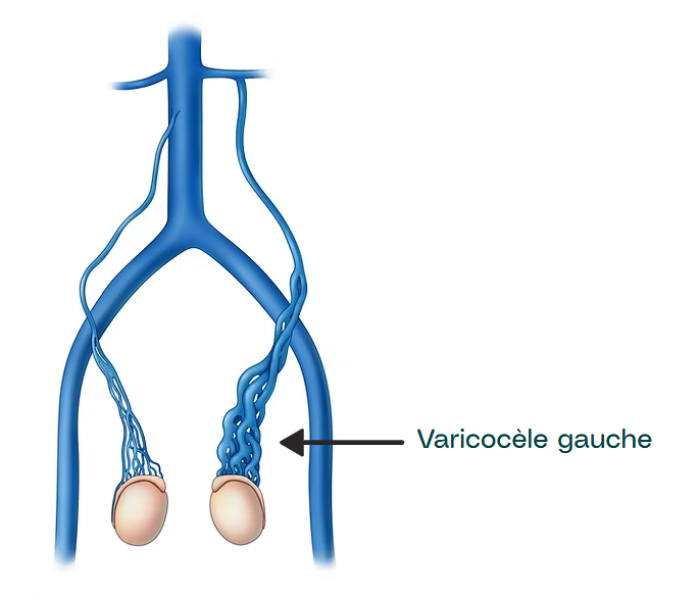
Varicocele corresponds to an abnormal dilation of the veins of the spermatic cord (pampiniform venous plexus) which drain the testicle.
It is comparable to varicose veins located in the scrotum , most often on the left side.
This dilation leads to blood stasis and therefore an increase in testicular temperature , which can impair the quality and production of sperm .
What are the symptoms?
A varicocele can be:
- Asymptomatic, discovered incidentally during an infertility assessment.
- Or manifest by:
⚠️ Testicular discomfort or heaviness , especially at the end of the day or during exercise.
⚠️ A decrease in testicular volume on the affected side.
⚠️ Male infertility linked to an alteration of spermatogenesis.
What is the link between varicocele and fertility?
Varicocele is one of the most common causes of male infertility , occurring in approximately 15% of men and up to 40% of infertile men .
It acts through several mechanisms:
⚠️ Increased testicular temperature , harmful to sperm production.
⚠️ Hypoxia and oxidative stress damaging the testicle.
⚠️ Alteration of spermatogenesis with decrease in normal sperm concentration, mobility and morphology.
💡 Surgical treatment often allows a significant improvement in the spermogram and a restoration of natural fertility potential , sometimes avoiding the need for medically assisted procreation (MAP).
The diagnosis
The diagnosis is based on:
- Clinical examination, which allows varicocele to be classified into several grades according to its visibility and palpability.
- A spermogram, systematic in the event of paternity plans, in order to assess the impact on fertility.
- Scrotal ultrasound with Doppler, which confirms dilation of the veins and venous reflux.

Microscopic surgery via the subinguinal approach
Principle
The standard treatment today is microscopic subinguinal surgery , which consists of ligating the dilated veins responsible for reflux, while preserving the testicular arteries and lymphatic vessels .
This technique is performed:
✅ Under general anesthesia
✅ Through a small incision (2 to 3 cm) under the groin crease.
✅ With the help of an operating microscope , allowing fine dissection and precise identification of structures.
Advantages of microsurgical technique
Compared to other approaches (laparoscopy, radiological embolization, high route), the subinguinal microsurgical route presents:
An extremely low relapse rate.
A more marked improvement in sperm parameters.
Almost no recurrence of hydrocele (thanks to the preservation of the lymphatics).
Better preservation of long-term testicular function.
A rapid resumption of activities.
A better spontaneous pregnancy rate after treatment.
Post-operative care
Principle
The procedure is outpatient (return home the same day).
Moderate discomfort may persist for a few days.
Sexual intercourse and sport are usually resumed after 2 to 3 weeks .
A clinical and ultrasound check-up is recommended at 3 months, along with a follow-up spermogram to assess functional recovery.

In summary
Varicocele is a common condition that can affect male fertility.
Infrainguinal microsurgical surgery currently represents the most precise and effective technique for correcting varicoceles, with proven reproductive results and optimal postoperative comfort.
Expertise
Varicocele
Dr. Benarroche offers individualized care for varicocele, from precise diagnosis to surgical treatment when necessary.
FAQ – Frequently Asked Questions
When should varicocele surgery be performed?
In cases of associated male infertility, painful discomfort, or testicular atrophy.
Can you get pregnant naturally after surgery?
Yes, in many cases, spontaneous improvement in fertility is observed after the procedure.
Is embolization an alternative?
Yes, it can be offered in some cases, but the results on fertility and recurrence rates are generally less favorable than with microsurgery.
How long before seeing an improvement in sperm count?
Improvement is often observed after 3 to 6 months, corresponding to a complete cycle of spermatogenesis.
Experience
Academic background
Dr. Benarroche offers a male-focused approach to care, combining medical and surgical approaches, adapted to the needs of each patient.
Specialized management of varicocele.
Contact me today for a personalized consultation